
A few precise injections can do a lot, whether that means softening dynamic lines with neuromodulators or restoring lost volume with hyaluronic acid fillers. If you are a medical professional looking to break into aesthetic medicine, one of the first questions you will face is where to begin. Should you start with Botox certification or dermal filler certification?
Both are rewarding paths, and most injectors eventually train in both. But the order you learn them matters more than people expect. As a National Allergan Trainer and master injector who has guided many providers into the field, Dr. Tara Delle Chiaie sees this question constantly, and her answer is grounded in what actually builds safe, confident injectors. Below, we break down what each certification involves, who each one is for, and why the order you choose can shape how smoothly your career starts.
Key Takeaways
- Botox certification is usually the recommended starting point, thanks to its foundational role in injectable treatments.
- Dermal filler certification builds on that base, rewarding strong anatomical knowledge and an artistic eye.
- Both require an active medical or nursing license, and both demand hands-on, supervised training.
- Earning both certifications lets you offer more complete treatment plans and grow your practice.
- The best injector training courses prioritize anatomy, safety, and real practice on live models.
Who Can Train as an Injector?
Aesthetic medicine is a clinical specialty, so injector training courses are built for licensed healthcare professionals. Before enrolling in any program, confirm you are eligible. Training is generally open to:
- Physicians (MDs, DOs)
- Nurse practitioners (NPs)
- Physician assistants (PAs)
- Registered nurses (RNs)
- Dentists (DDS, DMD)
Requirements vary by state and provider type, so always check your local scope of practice. At DCCM Academy, our hands-on courses require an active New Hampshire medical license or a compact state license, and we are happy to help you confirm whether you qualify.
What Botox Certification Covers
Botox certification introduces you to neuromodulator injections, the treatments most people associate with smoothing crow’s feet, frown lines, and forehead wrinkles. These courses are protocol-driven, which makes them an approachable entry point. The focus is on safety, anatomy, and precise dosing.
A solid Botox course covers:
- Facial muscle anatomy and nerve mapping
- Patient assessment and consultation
- Proper dilution, reconstitution, and product handling
- Injection technique for common treatment areas
- Recognizing and managing complications
- FDA-approved products like Botox, Dysport, Xeomin, Jeuveau, and Daxxify
Because the protocols are clear and repeatable, starting here helps new injectors build confidence and muscle memory while internalizing patient safety. It is exactly why our Cosmetic Neurotoxin course is where so many providers begin.
What Dermal Filler Certification Covers
Dermal filler certification moves from softening lines into restoring volume and reshaping contours. Hyaluronic acid fillers can address midface volume loss, nasolabial folds, marionette lines, lips, and the jawline. It is as much art as science.
Filler training goes deeper, both literally and technically:
- Advanced facial anatomy, including vascular structures and danger zones
- Patient selection and treatment planning
- Techniques like linear threading, bolus, fanning, and cross-hatching
- Product knowledge and how different fillers behave
- Recognizing and managing complications such as vascular occlusion
- Artistic principles for balance and symmetry
Because fillers carry more variability and higher risk than neuromodulators, most training programs recommend getting comfortable with Botox first. That foundation makes the jump to fillers far smoother. DCCM Academy’s Essentials of Dermal Filler course builds on that exact progression, layering filler artistry atop a strong anatomical foundation.
Botox vs Dermal Filler Training at a Glance
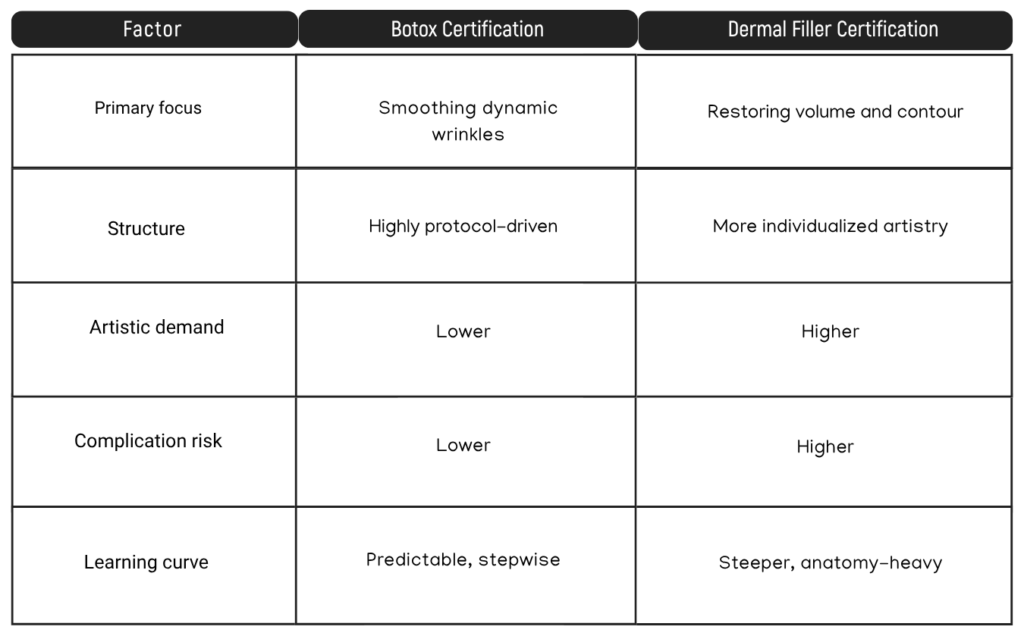
The takeaway is simple. Botox training tends to be the gateway to aesthetic medicine because it is structured and methodical, whereas filler training introduces more variables and requires advanced anatomical judgment.
Which Should You Learn First?
For most people, the answer is Botox, then fillers. But your background matters, so here is how to think about it.
Start with Botox certification if you want to:
- Master clear protocols before taking on more variable work
- Build baseline confidence with injectables
- Minimize early complication risk while you sharpen your consultation skills
- Lock in safety and anatomy fundamentals first
Consider starting with dermal fillers if you:
- Already have strong anatomical knowledge from a surgical or facial specialty
- Are drawn to creative, artistic work and complex aesthetic decisions
- Want to specialize in facial enhancement and contouring from the start
- Are ready for a steeper learning curve and committed to ongoing education
Some experienced injectors begin with fillers. For most, though, the stepwise route starting with neuromodulators is the safer, more confidence-building path. If you are still weighing it, our guide on how to become a Botox injector is a helpful read.
Why Most Injectors Train in Both
Choosing your first certification matters, but it is rarely the end of the road. Most injectors eventually train in both Botox and fillers because together they allow you to offer complete, personalized treatment plans and address a wider range of patient goals. From a business standpoint, dual training also makes you more competitive and supports a longer career.
A common path looks like this:
- Earn your Botox certification to build a foundation in anatomy, safety, and technique.
- Gain real experience and confidence with neuromodulator treatments.
- Add dermal filler certification, expanding into volume and contouring.
- Keep growing with advanced courses and ongoing education.
At DCCM Academy, you can move through this progression in one place. Our 4-day Aesthetic Immersion Program bundles cosmetic neurotoxin, structural dermal filler, facial assessment, and lip techniques, so you can build both skill sets with expert guidance.
How Certification Translates Into Career Growth
For many injectors, the real draw of aesthetic medicine is the lifestyle: better hours, higher earning potential, and patient care without the grind of traditional healthcare. Demand for cosmetic treatments keeps climbing, and skilled injectors are in short supply.
Botox certification often opens the door fastest, since neuromodulator treatments are the most requested and easiest to add to a practice. Dermal filler certification then widens what you can offer, from volume and contouring to lip enhancement. Together, the two build a fuller menu of services, attract a broader client base, and raise the value of each visit, which is why many injectors find that aesthetics becomes one of the most rewarding parts of their work.
Common Mistakes New Injectors Make
A few missteps tend to trip up injectors early, and most are avoidable with the right training:
- Rushing into fillers too soon: Without a solid neuromodulator foundation, the steeper learning curve and higher risk of fillers can overwhelm new injectors.
- Choosing a course with shared models: Splitting one patient among several students means far less hands-on time, which is where real skill is built.
- Underestimating anatomy: Surface technique is not enough. Deep anatomical knowledge is what prevents complications.
- Stopping at the certificate: The best injectors treat certification as a starting point, not a finish line, and keep refining through advanced courses and mentorship.
Knowing these pitfalls ahead of time helps you choose a program and a path that sets you up to succeed.
How Long Does It Take to Get Certified?
One of the most common questions from aspiring injectors is how quickly they can start treating patients. The encouraging answer is that foundational certification does not take long. Many introductory Botox and dermal filler courses are completed in a matter of days, and at DCCM Academy, the 4-day Aesthetic Immersion Program covers neurotoxins, fillers, facial assessment, and lip techniques in a single intensive week.
That said, certification is the beginning of your skill-building, not the end. True proficiency comes from repetition, mentorship, and continued education over time. The goal is not just to finish a course, but to leave it genuinely ready to treat patients with confidence.
What Makes a Quality Injector Training Program
Not all aesthetic medicine training is equal. As you compare programs, look for:
- Faculty with deep clinical and teaching experience
- Thorough didactics covering anatomy, pharmacology, and complications
- Supervised, hands-on practice on live models, not just observation
- Small class sizes for real feedback
- A current curriculum that reflects best practices and FDA guidance
- Clear guidance on scope of practice and compliance
This is the standard we hold ourselves to. Every DCCM Academy course is led by Dr. Tara Delle Chiaie, a National Allergan Trainer and master injector, in small groups where you treat your own live models with premium products provided, and earn 10 CME/CEU hours. A great program gives you more than a certificate. It sets you up for a safe, successful career.
Start Your Aesthetic Medicine Training at DCCM Academy
Whether you begin with Botox certification or dermal filler certification, the keys are the same: hands-on experience, a strong safety foundation, and expert mentorship. DCCM Academy helps licensed medical professionals build the skills and confidence to thrive as independent injectors.
Call 603-601-7076 to talk through which course is the right starting point for you, or to reserve your spot in an upcoming training.