Dermal fillers have become one of the most sought-after treatments in modern aesthetics, helping patients restore youthful volume and enhance facial contours with minimal downtime. However, as with any injectable procedure, complications can occur. Understanding how and why these complications happen, along with knowing how to prevent and manage them, is essential for every injector.
At DCCM Academy, injector education goes beyond technique. True mastery requires understanding facial anatomy, product science, and the clinical judgment needed to respond appropriately when complications arise. Our advanced aesthetic injector courses teach practitioners how to combine artistry with medical precision while managing even the most complex filler complications.
Understanding Dermal Filler Complications
A dermal filler complication is any unexpected or undesirable outcome following filler injection. These may range from mild and temporary issues, such as swelling or bruising, to more serious concerns that require prompt medical attention.
While filler treatments are generally safe when performed by skilled professionals, complications can occur due to improper injection technique, product placement, or patient-specific factors.
Injectors must be able to identify complications early and manage them effectively to minimize risk and preserve patient trust. Learn more about advanced safety practices through our Dermal Filler: Mid-Facial Structure Course, which emphasizes anatomical precision and vascular awareness.
Common Types of Dermal Filler Complications
Dermal filler complications can be categorized as early or delayed based on when they appear after treatment. Each type requires a different approach to diagnosis and management.
Early Complications
Early complications occur within hours to days after injection and are often related to the injection process itself.
Common early complications include:
- Bruising and swelling: Typically mild and temporary, but can indicate trauma or vascular involvement.
- Pain and tenderness: Common immediately after treatment, but severe or increasing pain may signal vascular compromise.
- Nodules or lumps: Often due to uneven product placement or localized inflammation.
- Vascular occlusion: The most serious early complication, caused by filler inadvertently entering a blood vessel and blocking blood flow. This can lead to tissue necrosis if not treated immediately.
Delayed Complications
Delayed complications may occur days, weeks, or even months after injection and can be related to immune response, infection, or filler degradation.
Common delayed complications include:
- Infection or biofilm formation: Can present as redness, swelling, and tenderness at the injection site.
- Granuloma formation: A rare inflammatory reaction that results in firm nodules.
- Migration of filler: Occurs when product moves from the original injection site due to improper technique or product choice.
- Delayed hypersensitivity reactions: Immune-mediated responses that may appear long after treatment.
Recognizing these patterns allows injectors to identify the underlying cause and take appropriate corrective action. Proper injector education and adherence to safe injection protocols, ike those covered in our Cosmetic Neurotoxin Courses, can significantly reduce these risks.
Vascular Occlusion: Recognizing and Managing the Most Serious Complication
Among all dermal filler complications, vascular occlusion demands the most immediate and skilled intervention. It occurs when filler obstructs a blood vessel, restricting oxygen supply to surrounding tissues.
Early signs of vascular occlusion include:
- Sudden, severe pain during injection
- Blanching or whitening of the skin
- Mottled or dusky discoloration
- Coolness or delayed capillary refill in the affected area
Management steps for vascular occlusion:
- Stop injecting immediately
- Massage the area to disperse product and restore circulation
- Apply warm compresses to promote vasodilation
- Administer hyaluronidase promptly if using a hyaluronic acid filler to dissolve the obstructing material
- Consider aspirin therapy to reduce clot formation if appropriate
- Monitor closely for tissue recovery and signs of necrosis
- Early detection and decisive action are critical. Proper injector education and hands-on emergency training can prevent permanent damage and safeguard patient outcomes.
Early detection and decisive action are critical. Proper injector education and hands-on emergency training can prevent permanent damage and safeguard patient outcomes.
Injectors can refine their emergency response skills through our Private Training with Dr. Tara Delle Chiaie, DNP, which includes simulations of real-world complication management.
Preventing Dermal Filler Complications
Prevention begins with knowledge. Even the most experienced injectors must adhere to best practices in anatomy, technique, and patient care to reduce risk.
Key strategies for complication prevention include:
1. Master Facial Anatomy
A deep understanding of vascular pathways, nerve structures, and tissue planes is fundamental. Injectors should be able to visualize underlying anatomy in three dimensions and understand variations between patients.
2. Use the Right Product for Each Area
Not all fillers are interchangeable. Selecting a filler with the appropriate viscosity, elasticity, and longevity for the target area helps minimize complications such as migration or nodule formation.
3. Follow Safe Injection Techniques
- Always inject slowly and with minimal pressure
- Aspirate before injection when appropriate to reduce intravascular risk
- Use cannulas in high-risk zones to reduce the chance of vascular penetration
- Avoid overfilling or layering multiple products without proper integration
4. Conduct Thorough Consultations
Assess patient history, allergies, medications, and previous filler treatments. Understanding patient goals and expectations also reduces dissatisfaction and the perception of complications.
5. Maintain a Sterile Technique
Prevent infection by following strict aseptic protocols, including disinfecting the skin and using sterile tools for each procedure.
Managing Common Filler Complications
When complications occur, calm, confident, and informed management can turn a potentially negative experience into an opportunity to reinforce patient trust.
Bruising and Swelling
- Apply cold compresses immediately after treatment
- Recommend arnica or bromelain to reduce bruising
- Reassure patients that mild swelling typically subsides within days
Nodules and Lumps
- Gentle massage may help redistribute product
- Persistent nodules may require hyaluronidase or corticosteroid injections
Infection
- Initiate oral antibiotics if signs of infection appear
- Avoid drainage or invasive manipulation to prevent biofilm disruption unless necessary
Granulomas
- Confirm diagnosis and manage with corticosteroids or hyaluronidase if related to hyaluronic acid fillers
- Consider referral for biopsy if lesions persist
Delayed Hypersensitivity
- Treat with antihistamines or corticosteroids
- Monitor for recurrence and evaluate filler type before future treatments
- Consistent follow-up appointments and open communication are key to managing complications effectively
The Role of Education and Training
Even the most skilled injectors benefit from ongoing education. The aesthetic industry continually evolves with new filler formulations, advanced injection techniques, and improved safety standards. Continuous learning ensures injectors remain confident and capable in both prevention and complication management.
At DCCM Academy, training programs emphasize a comprehensive understanding of:
- Facial anatomy and danger zones
- Safe injection protocols
- Early recognition of vascular events
- Hyaluronidase administration and complication reversal
- Patient communication and informed consent
Through simulation-based learning and expert mentorship, injectors gain the experience necessary to respond swiftly and appropriately in real-world scenarios.
Legal and Ethical Considerations
Managing complications extends beyond clinical skill. Injectors must also uphold ethical and professional standards.
Key points include:
- Informed consent: Patients should be fully aware of potential risks and treatment options before receiving filler.
- Documentation: Accurate records of treatment details, filler type, injection sites, and responses are essential for continuity of care.
- Follow-up: Providing accessible post-treatment support builds patient confidence and ensures proper healing.
Adhering to these principles protects both patient well-being and injector reputation.
The Importance of Confidence and Preparedness
While the goal is always prevention, complications can happen even under ideal circumstances. What distinguishes an expert injector is not the absence of complications, but the ability to handle them effectively. Preparedness, clear communication, and advanced knowledge are the foundation of patient safety and professional success.
DCCM Academy empowers injectors to elevate their practice through comprehensive education in both artistry and safety. Mastery of dermal filler complications ensures that practitioners not only deliver beautiful results but also uphold the highest standards of care in aesthetics.
Patient Communication and Managing Expectations
Even when procedures are performed with precision and care, patient perception plays a major role in how outcomes are received. Understanding how to manage patient expectations and maintain transparent communication throughout the treatment process can prevent misunderstandings and reduce emotional distress if complications arise.
Strategies for effective communication include:
- Educate before treatment: Clearly explain potential risks, side effects, and the normal healing process during the consultation. Patients who understand what to expect are less likely to perceive standard reactions like mild swelling or bruising as complications.
- Stay transparent: If a complication occurs, communicate honestly and calmly. Explain what happened, why it may have occurred, and what steps are being taken to correct it.
- Offer reassurance: Patients often experience anxiety when outcomes differ from expectations. Demonstrating empathy, professionalism, and confidence helps build trust and improves the overall experience.
- Provide structured follow-up: Schedule check-ins to assess healing progress and reinforce patient confidence in your care. Regular communication reduces the likelihood of dissatisfaction or negative reviews.
By combining technical expertise with compassionate communication, injectors can transform potentially stressful situations into opportunities to demonstrate their professionalism and commitment to patient safety.
Train with the Experts at DCCM Academy
Dermal filler complications require technical expertise, anatomical understanding, and clinical confidence. DCCM Academy provides advanced injector education designed to prepare practitioners for every scenario, from routine treatments to rare complications.
Our courses combine hands-on training with expert instruction, focusing on both aesthetic outcomes and patient safety. Whether you are an experienced injector or new to the field, mastering complication management is an essential step toward excellence in medical aesthetics.
Advance your skill, protect your patients, and lead with confidence. Explore our injector training programs and become the professional patients trust for safe, exceptional results.
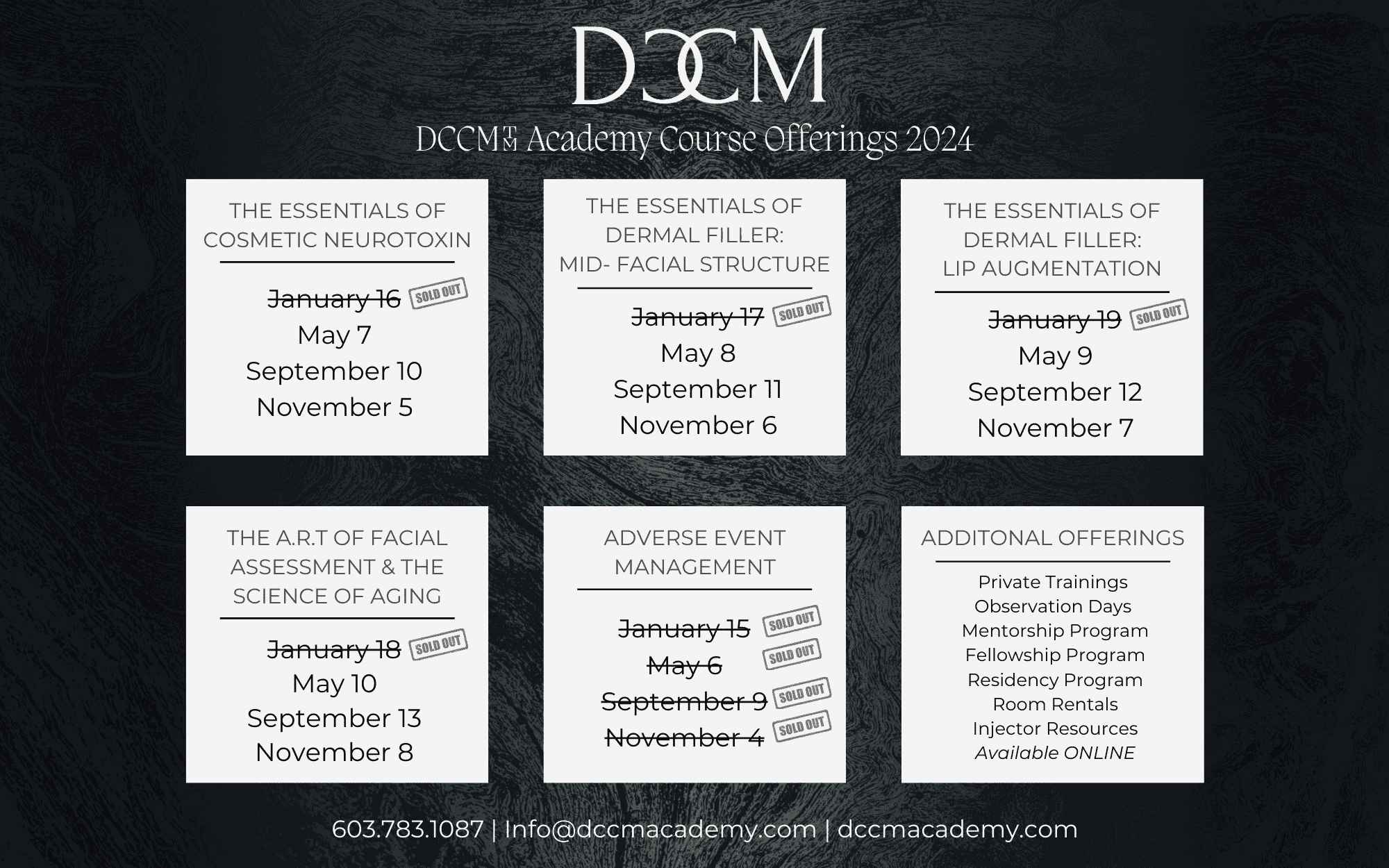
2024 Course listings